
Instrument values over time
This functions is used to generate a sequence displaying a change of an instrument value over time for the input signal.
In order to calculate instrument values from input signal and to show all calculated values in a new signal sequence, you can also use log instrument value function. But, that function is best suited for live input signal where one instrument value is calculated for each new data acquisition block. To do the same for a loaded signal file, you can use this function, available from Signal tools/Instrument values over time... main menu option.
After selecting this menu option, the following dialog will appear:
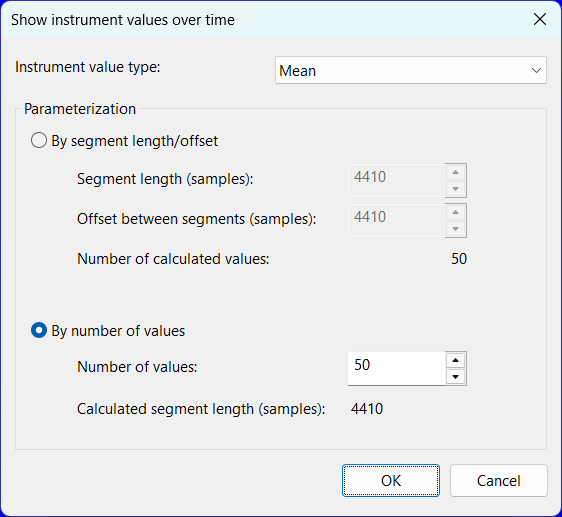
You can choose instrument function to be calculated from a subset of all instruments available in SIGVIEW.
There are two alternative ways to define the calculation parameters:
•Specify segment length and segment offset: In this mode, you define the length of each segment (in samples) used to calculate a single instrument value, as well as the offset (in samples) between consecutive segments. Based on these settings, SIGVIEW will calculate how many values will be generated and display the resulting number.
•Specify number of result values: In this mode, you directly define how many instrument values should be produced. All other parameters, such as segment length and offset, are then calculated automatically to match the selected number of values.
After pressing OK, the calculation procedure will be started. It will divide a visible part of the input signal into segments of a defined length. Each new segment will be shifted relative to the previous segment by using a defined offset (step) value. All calculated values will be the same as if the corresponding instrument function was used on a corresponding signal segment.

By using Properties... option from the context menu, you can change all properties of the calculation (instrument type, segment length, offset).